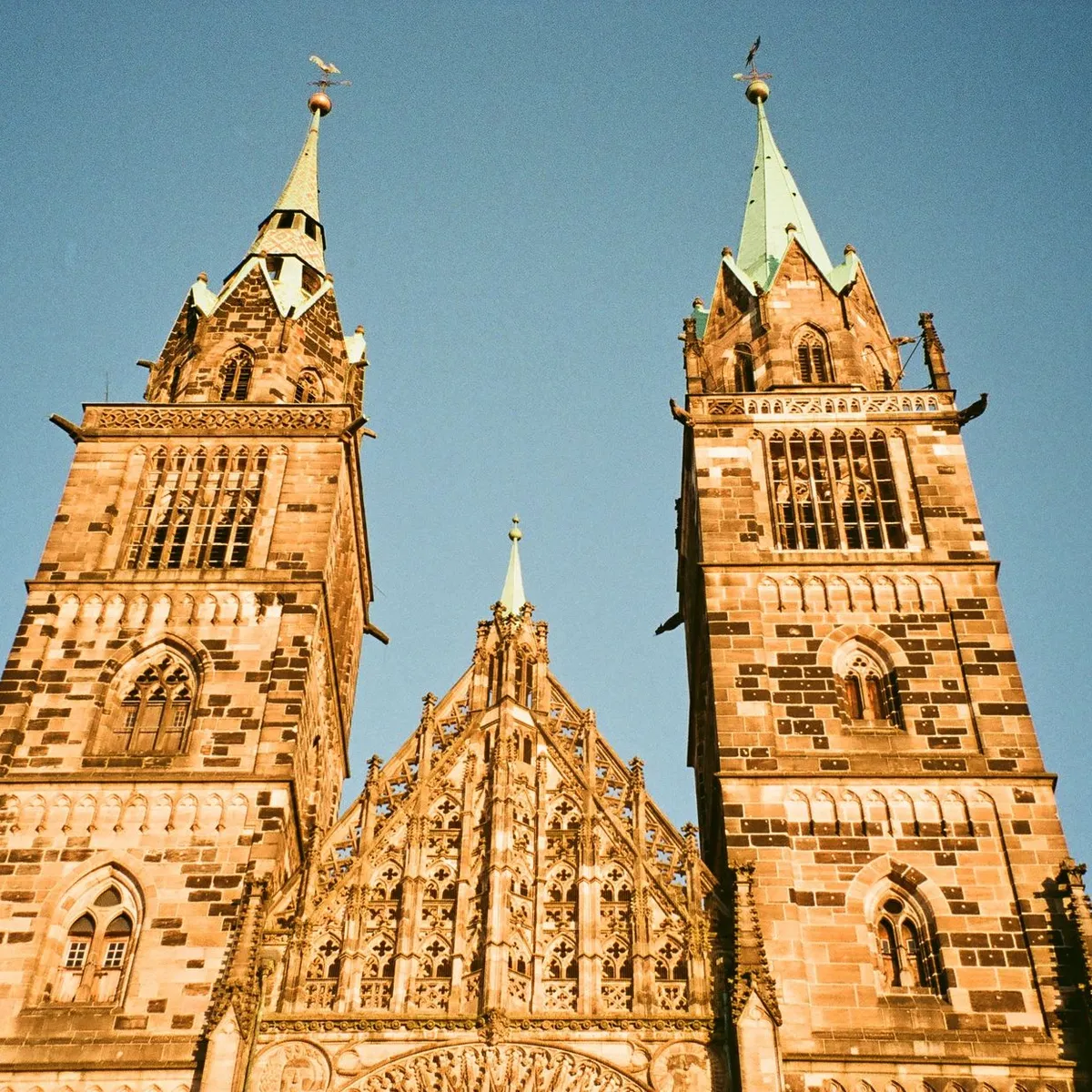
 Photo: Alexey K. / Pexels
Nürnberg
Nürnberg accessibility for wheelchair users
Compare Nürnberg by accessibility, transport, terrain, healthcare, cost, weather, laws, reviews, and community notes.
Nürnberg accessibility scores
Compare Nürnberg by accessibility, transport, terrain, healthcare, cost, weather, and laws. General stats use public data and models. Community rows reflect member reviews and votes.
General stats
National benchmarks and estimates — your experience in this city may differ.
Community
Starts from our estimate — thumbs up nudge toward Excellent, down toward Poor. Reviews use 1–5 stars.
These figures combine public statistics, models, and live weather where available. Every city is different — treat this as a guide, and share what you know in the Reviews & Corrections tab.
Profile last updated 6/30/2026.
Nürnberg wheelchair accessibility guide
Research Nürnberg for wheelchair users and caregivers: getting around, terrain, healthcare, costs, climate, accessible things to do, and practical caveats before booking.
Last updated 6/30/2026At a glance
Nürnberg is one of Germany’s most useful mid-size city bases: historic core, strong rail links, museums, and lower costs than Munich. The local snapshot scores it 76 overall, with infrastructure 85, terrain 61, population about 499,000, and living cost from ~$3,460/mo. Wheelchair users should like the compact transit network and high-confidence pavement data, while treating the medieval old town, castle hill, and cobbled streets as real mobility constraints.
Getting around
VGN/VAG public transport is the backbone: U-Bahn, trams, buses, and S-Bahn links. Check barrier-free station pages, elevator status, and vehicle access for the exact route. Nürnberg Hauptbahnhof is a useful arrival point, but train assistance, platform lifts, and onward elevator routes should be booked or checked through DB/VAG before travel.
Terrain & mobility
The OSM pavement profile is strong: 80% good, 0% poor, high confidence, with asphalt, paving stones, untagged, and compacted surfaces. That does not mean the Altstadt is effortless. Expect cobbles, drainage channels, crowds around Hauptmarkt, and steeper approaches toward Kaiserburg. Pick hotel locations near confirmed step-free U-Bahn/tram stops rather than inside the most atmospheric but uneven lanes.
Healthcare & care
OSM healthcare leads include Klinik am Gräslein, Cnopf’sche Kinderklinik, Cardiologisches Centrum, Internistische Fachklinik Dr. Steger, and Maximilians-Augenklinik. These are not access guarantees. For a stay, verify which hospital/clinic matches your needs, accessible entrances, after-hours care, and German/English communication.
Costs & housing
Use the DB estimate from ~$3,460/mo. Accessible short-stay apartments are easier to evaluate in newer districts than in old buildings. Ask for lift dimensions, threshold photos, bathroom turning space, shower type, and whether street-to-lobby access crosses cobbles, a slope, or heavy market crowds.
Climate & comfort
Winters can be cold and icy, and Christmas-market crowds make the center beautiful but hard to navigate. Summer is generally manageable, with shaded museum and café breaks important on stone-paved routes.
Accessible things to do
Germanisches Nationalmuseum— major indoor museum; verify current accessible entrance, lifts, accessible toilets, and exhibition-route closures before visiting.
Dokumentationszentrum Reichsparteitagsgelände— important history site; check accessible exhibition route and distances across the grounds.
Hauptmarkt and St. Lorenz area— central, atmospheric, and useful for orientation; surfaces and crowds vary, so scout quieter approaches.
Kaiserburg Nürnberg— iconic but hill-and-surface sensitive; contact the site for step-free portions and consider enjoying views/outer areas rather than assuming full access.
Community & language
German is the working language, but English is common in tourism. Disability access information is often published under “barrierefrei”; keep screenshots for transit staff and venues. For longer stays, ask disability organizations or your insurer about equipment repair, hoist rental, and home-care providers before arrival, because hotel concierges may not know specialist suppliers.
Would we recommend it?
Yes, especially for culture and rail-based travel, if you plan around cobbles and hills. It is a better fit for users who can tolerate some uneven old-town surfaces or who are happy to focus on accessible museums and transit corridors. Choose accommodation on a verified step-free transit corridor rather than optimizing only for old-town charm.
These figures combine public statistics, models, and live weather where available. Every city is different — treat this as a guide, and share what you know in the Reviews & Corrections tab.
Profile last updated 6/30/2026.
Reviews & corrections
Share your experience or suggest a data correction. Both appear publicly; admin updates official city scores and costs separately.
Log in to write a review or suggest a correction.
No reviews or corrections yet.